Monday, April 6, 2020

MEMORIES

It's funny how pandemics and quarantines and confinement in small spaces play tricks on the mind. I've never been the sort of person who dwells on the past or even looks back on "halcyon days." But now, to quote Dante, in the middle of life, I find myself in a dark wood wandering, pining away for lost days, bygone decades when I was a younger, more adventurous - sometimes alarmingly so - person. But, a life without regrets is a life not lived. Sorry to get philosophical here but the peculiar atmosphere, which I believe we are all experiencing, has forced me, at least, to look back and try to tap into happier times. 

Being Italian, most of the stories of glory are surrounded by celebrations of food and music, and here is one of them. Many years ago - almost a lifetime really - I had the great fortune to study piano with a very famous teacher in Rome. It was the summer of 1982 actually, and I was bopping around Italy doing the piano competition circuit and landed in Rome for a few week before I would be forced to lasciare la bella Italia. He put me up for a few days in his palatial apartment before finding me smaller accommodations with a piano a few blocks from the Colosseum. In any event, the first night I was there, I played for him (a copious program of Bach, Beethoven, Brahms, and Chopin) and then he cooked dinner. It is with genuine affection that I look back to that evening, laced with good wine, good conversation, dining with some of his other students on some of the best pasta with tuna I ever had. Well, it was the first time I had ever had it, really, and even when I make it, it doesn't come close to how his tasted. I remember asking: "what is this? Veal?" And of course, it was tuna cooked in tomatoes with all the right Roman spices (garlic, pepperoncini, etc.)  Here it is, pictured below with linguini.
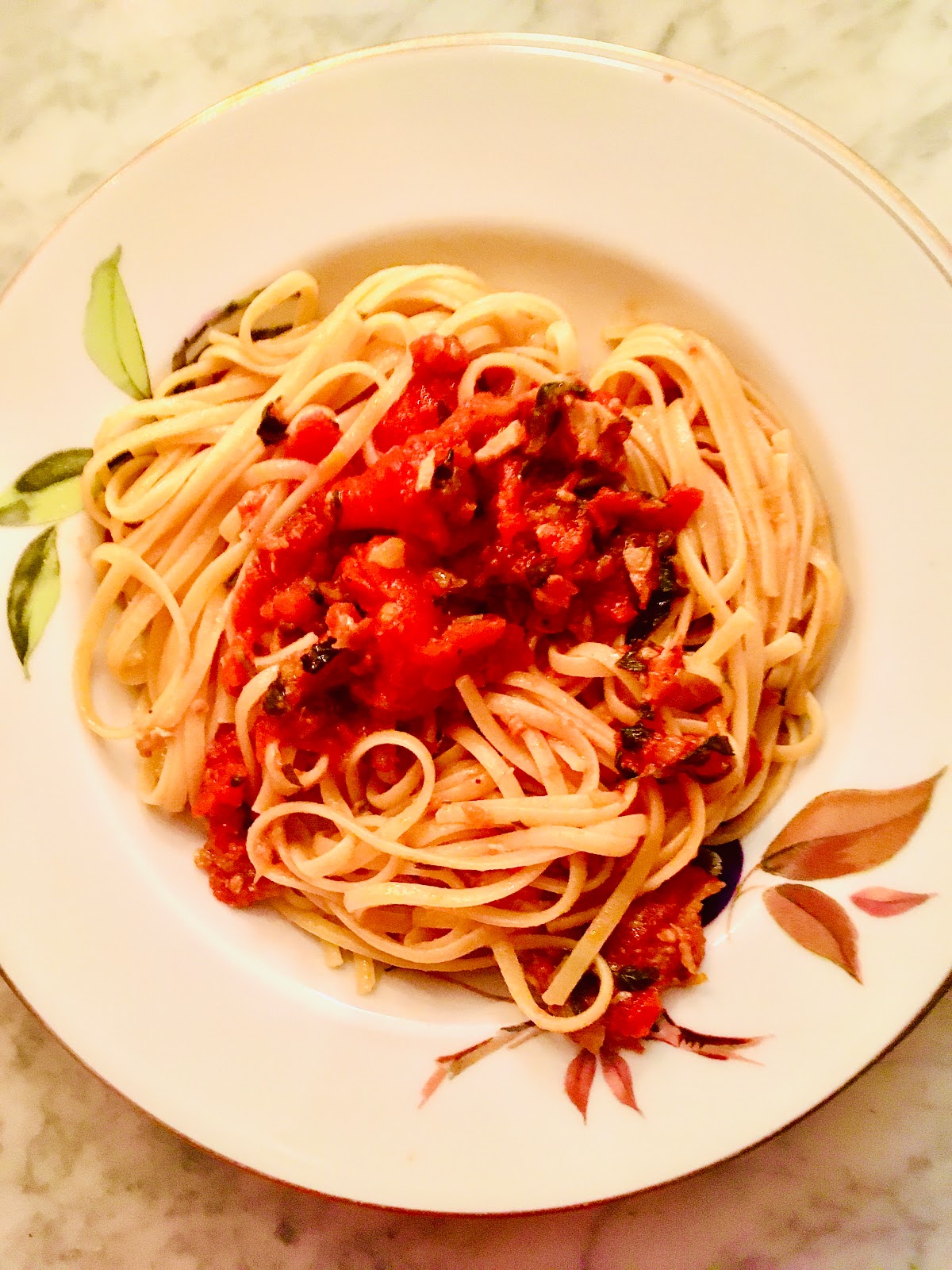

Serves 4

1 lb. linguini (or any kind of pasta you like, any macaroni with ridges will do good because the sauce adheres to the ridges)

1 medium onion minced
2 stalks celery minced
1 small carrot (fine dice)
4 cloves garlic
1/4 tsp. pepperoncini flakes
a handful of parsley chopped fine
12 basil leaves cut in chiffonade 
2 sprigs fresh thyme
8 oz. tuna packed in oil (I make my own - highly superior to anything canned, but the Sicilian tuna in jars does very nicely here)
1/4 cup white wine
1 large can imported peeled, whole tomatoes (since the price of tuna is rather dear you might as well splurge and go whole hog on San Marzano tomatoes!)

Sauté the soffrito (onions celery, and carrots) and the garlic in olive oil until translucent. Add the pepper flakes and the herbs and continue to cook for a moment and then add the tuna. Cook for a few minutes over moderate heat, add a sprinkling of white wine and allow to reduce and then add the tomatoes. I recommend emptying the can into a large bowl and crush the whole tomatoes with your hands to break them up a bit before adding to the pot.

Add 1/2 tsp salt and few grinds of a pepper mill. Bring to the boil and then lower heat to a simmer and let cook partially covered for about 2 hours. Correct seasoning, if necessary, before dressing the pasta.

Boil a large pot of water, add a handful of Kosher salt and then the pasta. Cook according to the direction on the package. Dress the pasta when cooked with the sauce and serve. No cheese please - it's fish!

Buon appetito!

Saturday, April 4, 2020

Viral Days

Braising Bulbs

It has been a seriously long time since I've deigned to write here much less compose something for aficionados of La Cucina. Be that as it may, it would seem that many people, forced to remain at home and thus rely on their own resources, have begun to take up cooking and baking with a vengeance. I must confess that I, too, am one of them. Necessity, after all, really is the mother of invention.

How does one pass the time when living alone, without a television, and for whom, besides playing the piano, watching the vacant lanes of West 14th Street from his window has become his only source of entertainment? I mean, there are just so many episodes of anything on Amazon Prime and Netflix one can watch. I've started re-reading Dickens (Trollope is next!) - always a challenge considering the length of their stories - to while away the hours. Don't get me wrong, I am still practicing in earnest but there is something unsettling about making so much noise when everything around you - especially in New York - is so still. It would be different if this were Westchester or an acred suburb anywhere in America or atop a mountain in Switzerland, but it's not.  We are here in the lively, 8-million-souls-filled metropolis of New York and everyone is either home, behind closed doors or escaped to parts unknown. The silence here is bloody deafening. My building, I am told, is only half full at the moment. Vewy scawy!

Nevertheless, I am here to talk about food so . . . let's start with Fennel. First of all, unlike most people you hear on the news, my grocery stores have been pretty well stocked. There have only been a few isolated instances where shortages remain constant, flour being the most prevalent; even "00" on Amazon has a 3-week waiting time. I haven't had any problems getting eggs or milk or butter, and vegetables have been ready for plucking from the shelves. I love fennel, especially raw, sliced thin and dressed only with salt and pepper and a drizzle of olive oil (no vinegar!). It is simple, quick (if you have a mandolin) and deee-licious! I also like them sliced thin with slices of orange (same way). But during the wintry months, I love to braise the bulbs, cut in quarters.  

There are many ways to do this, even finish it off with cream and bake them au gratin. HEAVEN! I have done it many ways, but I think the best way is to simply braise them in broth with some finely sliced onions, a clove of garlic, some white wine and as you see in the picture, some roasted cherry tomatoes. It's fairly simple and takes no effort besides being forced to monitor the stove periodically and wait the required 2 hours before eating or serving.

Serves 8 as a vegetable or 4 as a main course with pasta or roast anything (game, fowl, meat, even fish)

2 whole bulbs Fennel
1 small onion or leek
1 clove of garlic (smashed)
1/4 tsp fennel seeds
1/4 tsp powdered thyme (or 2 fresh thyme sprigs removed before serving)
1 cup roasted cherry tomatoes
Extra Virgin Olive Oil
1/2 cup white wine
1 cup rich chicken stock
salt and pepper to taste at end 

Cut off stalks at top of the bulbs and mince the stalks and fronds and reserve
Cut off the hard base of each fennel bulb but without severing any of the leaves. Trim the bulbs by removing the tough outer leaves. Cut each bulb in half and in half again You should have 8 equal pieces.

Slice the onion very thin and reserve

In a large, heavy dutch oven (Le Creusets are perfect for this), heat the olive oil and add the fennel bulbs. Sauté the fennel on each side over moderate heat, including the rounded outside shell. When the bulbs are nicely browned, remove from the pan. Add the chopped garlic, the sliced onion and the minced fennel stalks and sauté until translucent. Add the fennel seeds and the thyme, stir a bit and add the fennel bulbs and the cherry tomatoes. Add the white wine and allow to reduce by half. Add the chicken stock, bring to the boil and lower heat to simmer. Cover and stir every once in a while for about 1-1/2 to 2 hours. Remove the cover during the last 20 minutes of cooking so the liquid in the pot reduces and thickens. Serve immediately.

There are so very many variations to this dish; the possibilities are almost endless. It is excellent served with game or fowl, especially goose or duck, and if allowed to cool and is then puréed, you can add it to a béchamel sauce and use it as the sauce base for a lasagna. The last time I made it, which was precisely at the beginning of our global ordeal, I added orzo to the broth. Perfect comfort food for anyone!


Sunday, October 1, 2017

Cannellini and Escarole Soup


I got this recipe from a cookbook by Jacob Kenedy who is the owner and chef of London's very popular restaurant Bocca di Lupo. It is as simple as apple pie - in fact, simpler - and doesn't take more than a half an hour to make except the cooking time for the beans, of course. It should be made immediately before serving because you don't want the escarole to be overcooked or turn black. 


1 lb. cannellini beans (soaked overnight and cooked in a pot of water with 1 tablespoon salt and 1 tablespoon olive oil brought to a boil and then cooked for three hours over moderately low heat.

2-3 cups of the bean cooking liquid kept in reserve for the soup

One head escarole, cleaned in a waterbath, stems at the root removed and sliced lengthwise into strips

Three cloves of garlic sliced very thin

One pinch of hot red pepper flakes

16 to 20 leaves fresh basil cut in strips lengthwise 

One bunch of chopped flat parsley

2/3 cup extra-virgin olive oil

Take half of the olive oil and heat it up in a large pot. Saute the garlic until it becomes golden at the edges, add the pinch of hot red pepper flakes and the cut up pieces of escarole. Season with a little salt and pepper and saute until wilted. Add the beans and the bean liquid and heat p to the boil. Lower the heat to a simmer and add the parsley and basil and the remaining olive oil. Stir well and serve with slices of toasted bread.

Tuesday, March 28, 2017

APPLE CHARLOTTE

I HAVE ALWAYS WANTED to make an Apple Charlotte. It isn't very difficult but it does take time. The basic recipe calls for stale bread; you know the French - Europeans in general, actually - they never waste anything! But, I am always tempted to gild the lily. I made a couple of pound cakes (Maida Heatter's Elvis King Pound Cake!) a few months ago and froze them with the express intention of eventually making one of these delectable concoctions with pound cake instead of bread.


I used Julia Child's recipe, which is completely over the top (minimal work but lots of steps). It was, in fact, the first time I ever used my Charlotte mold (fabrique en France). It's a happy occasion indeed when any batterie de cuisine designated for a particular use functions exactly as it should and succeeds. And even though the mold was silver tin, its heart-shaped handles render it rather fetching to the eye.

Funny thing here: Julia's recipe calls for 6 lbs. of apples. I stopped at 9 apples (not even 3 lbs.) and had more than plenty to fill the mold (I had enough left over to fill a jar of apple sauce). Frankly, I got tired of peeling and coring apples and gave up once my pot was almost full!

So to begin:

6 cups apples, cored and peeled and chopped coarsely into
   small pieces
1/4 cup rum
1/2 cup sugar
1/4 cup apricot jam (strained through a fine sieve)
3 tbl. unsalted butter
1/4 tsp. almond extract
1/8 tsp. salt

Place all the apples into a large pot (Le Creuset Dutch Ovens are the best for this or any stainless steel pot with a lid). Cover and cook over moderately low heat for 20-30 minutes. Stir occasionally. Apples should soften a bit. Add the sugar, jam, rum, butter, salt and almond extract and cook on relatively high heat. Bring to a boil and stir vigorously and often. (I let it simmer covered for about 30 minutes, stirring occasionally.) After about 45 minutes the apples should have melted somewhat into a kind of apple sauce/paste. You will need to keep stirring until all of the liquid has evaporated and a spoon draws a line on the bottom of the pan when swiped across. You should have a thick paste which when spooned up it one large mass. Turn off heat and cover until ready to use.


1/2 pound clarified butter 

Cut off the crusts of the bread or cake to make even squares and cut into 3 equal rectangular slices. Cut a round piece for the bottom of the mold with varying shapes to fill in the open spaces before lining the mold. You will need to saute the round pieces for the bottom until golden brown. Place in the bottom of a 3 inch high charlotte tin and dip each piece of bread into the clarified butter and line the wall of the mold, overlapping the slices as you go round the entire wall. Make sure you cut the pieces on the top to make everything level. Fill the mold with the apple mixture until you have a mound which is above the surface of the slices (the apples will sink as the charlotte bakes). Top the mold with more slices of buttered bread until it is completely covered. Pour the remaining clarified butter over the mold filling it completely with liquid. Place the mold into a larger pan (a ceramic dish is perfect for this) and place into a 425º over for 30-45 minutes or until the entire charlotte is a dark golden color. Running a knife in between the mold and the charlotte twill indicate if the bread has browned and finished. Let cool for at least 45 minutes before unmolding or refrigerate overnight and un-mold after reheating in a warm 190º oven for 30 minutes.

1/2 cup apricot jam
1/2 cup sugar
1/4 cup rum
a dash of almond extrac

Place ingredients in a small pan and bring to the boil. Stir to mix thoroughly and pout through a fine sieve. Brush the outside of the unmolded charlotte with the apricot glaze until very shiny and serve.


BON APPETIT!

Friday, February 24, 2017

INTRUGLIO

HAVE YOU EVER WALKED into an Italian grocery store, I mean the small, little ones, family owned, smelling of the old world, reeking of olives and salami and hard pungent cheese? 


Well, this dish represents that scent, the succulent aroma of olive oil mixed with fruits of the vines and trees. What's more, it might be a little pricey to make because olives and sun-dried tomatoes and cheese have become rather dear not to mention the extra virgin olive oil, but it is so simple to make that it's crazy.   


Etymologically, Intruglio (pronounced een -TRUE-leeyo - The G is silent when preceding L followed by I or E) means slop, muddle, concoction. I found this recipe in Tessa Kiros' gorgeous and fabulous cookbook: Venezia - food and dreams (page 71). She states that Intruglio is of Tuscan origin.  But it's altogether possible that this mixture is made throughout Italy where olives and tomatoes live in ubiquity. In Calabrese the word intruglio means pigswill, which it definitely is not! It even has had connotations like "bad medicine" and "paint stripper" throughout the ages and can be dated back as far as the Romans. Being an olive-oriented society, I'm sure they made full use of oil and salt to preserve foods like this.


This "concoction" is basically made using:


1 cup of Kalamata olives 

1 cup of large green olives 
1 cup of any other kind of olive (red or green or black for variety of type and color; I recommend pitted olives)

Mix with a quarter pound of soft goat cheese and a half pound of Buffalo mozzarella. Since Buffalo mozzarella is so expensive I just use the little bocconcini which I flatten with the palm of my hand. Mix all the ingredients in a large bowl and add either some fresh oregano or some rosemary with some thyme, a dash of hot red pepper flakes and a couple turns of black pepper from a pepper mill. Also optional: a heaping tablespoon of capers and some anchovies.


Pour the mixture into a large glass airtight container (those which are used for preserving are ideal) and add 1 to 1 1/2 cups extra-virgin olive oil to cover the mixture completely. Refrigerate for at least 2 to 3 days or up to a week and then you can start using it. I have used very little of it in the past and must say that it grows in flavor with a little aging. I use some and then cover it with more olive oil which will help the mixture to stay completely perfect for at least a month.


At this point you can top it on bread or crostini as an antipasto or dress any pasta of your choice with it.

Boil any kind of macaroni or pasta (shells, butterflies, rigatoni, penne) and cook until ready according to the instructions on the box. Drain, put back in the pot with a little bit of olive oil some black pepper and add about three large spoonfuls of the intruglio and mix thoroughly. Serve immediately with some grated Parmesan cheese.


A slight variation: Preheat the oven to 375°.

1/2 pound salt cod soaked in water for several days with changes of water every eight hours. Take a large piece of parchment paper put the cod on the paper, place about three very large spoonfuls of the intruglio over the fish, wrap the fish with more parchment paper and seal all around it. Put on a large roasting pan and roast for 20 minutes. When the fish is ready open up the parchment poor everything onto the pasta and mash the fish into the pasta with a wooden spoon so it's well incorporated. Serve immediately but without cheese. 
Buon appetito!


Wednesday, November 30, 2016

JALOUSIE STUFFED WITH MINCEMEAT


This dessert is so delicious and rich - and labor intensive - that it is probably best served only on holidays or very special occasions in Winter.


I say this because it requires making the mincemeat (and ample time in a jar to really develop into a true tipsy jelly), making puff pastry at least a day ahead of time and then assembling the dessert and baking it to a buttery, divinely flakey pastry full of delicious sweet meats redolent of baking days of yore.

MINCEMEAT

Mincemeat was usually made with drippings, suet and tongue which was simmered for hours and hours until the meat almost disappeared. To that was added fruits, berries and alcohol (as a preservative). Don't forget, this was something that predated refrigeration by centuries so the use of alcohol - and salt, but not in this instance - was a prevalent additive to deter spoiling or rot.

4 apples, peeled, cored, and cut into large chunks
1/2 stick unsalted butter
1/2 cup brown sugar
1/4 cup golden raisins
1/4 cup currants
1/2 cup chopped candied cherries
1/4 cup candied citron
Grated peel from 1 orange
Grated peel from 1 Lemon
Juice from one Leman
Juice from one Orange
1/8 tsp. ground cloves
1 tsp. cinnamon
1/8 tsp. nutmeg
Rum
Calvados (or Brandy)
1 cup chopped pecans

Put the apples in a food processor and pulse a few times until the apples are reduced to berry-sized shapes. Don't process too much.
Melt 1/2 stick of butter in a heavy cast iron pan (a Le Creuset Dutch oven is perfect for this) and add the apples. Sauté the apples for about 10 minutes and add the orange and lemon peel, the citrus juices, and 1/4 cup Rum. Let it boil and reduce. Add 1/2 cup brown sugar, and all other dry ingredients except the pecans. Stir until the mixture comes to the boil. Add 1/4 cup Calvados and bring to a boil again, turn down the heat and simmer covered for 45 minutes. Stir occasionally and add more liquor if mincemeat dries out or begins to stick to the bottom of the pan. I mix 1/4 cup of the rum with 1/4 cup Calvados and use this mixture to moisten the mincemeat when needed.

After the mincemeat has cooked and reduced into a thick mass, add the pecans and place contents into sterilized jars leaving an inch of space at the top. Cover mixture with any leftover liquor, seal and let cool in a dark place in a cupboard or the refrigerator. This should keep for several months.

PUFF PASTRY

1 1/2 cups all purpose flour
1 cup "00" flour
1/2 cup cake flour
1 tsp. salt

1 lb. unsalted butter
1/2 cup cold water

I've made this puff pastry several times now and it works every single time. 

Please the flours and the salt in a food processor and pulse for 3 seconds. Take one stick of butter and cut it into small dice. Add the butter to the food processor and pulse until the flour takes on the texture of meal and the butter has turned into little pellets. Add the water in a stream and process for 8-10 seconds or until the doug takes on a mass and clears itself from the wall of the canister. Turn out onto a floured work surface and knead into a ball. Dough will be very stick at first so dust your hands with flour. 

Cover the dough with plastic wrap and refrigerate for 30 minutes.

While the dough is chilling, cut the rest of the butter into patties and place in a large stainless steel bowl. Using your fist, punch the butter down and rake it with your fingers (like a claw) until the butter takes the shape of the bowl in a nice flat dome. Refrigerate. 

When you're ready to start rolling out the pastry, Roll our the dough into a large circle measuring at least 16 inches in diameter. Place the butter sheet on top of the pastry dough and fold the outside edges of the dough over the butter, completely encasing the butter. Roll out the dough and fold it into thirds. Cover and refrigerate for 30 minutes. When you're ready, roll out the dough into a 12x18 inch rectangle. Fold the dough into thirds and turn the dough 45º to the right. Roll out the dough, always starting from the center and rolling out and turning the dough so your rolling away from you. When you have another large rectangle, fold it into thirds again and refrigerate again for 30 minutes. Do this two more times exactly as before. Refrigerate. 

This can be refrigerated for up to 4 days or frozen for months. When you're ready to make the jalousie, removed the pastry from the fridge and cut the dough into two pieces. You can freeze one of the halves and save it for future use, Roll out the other piece of dough into a 12x16 inch rectangle. Cut the dough in half lengthwise. Place one of the sheets on a baking sheet lined with parchment paper moistened with drops of water. Place the mincemeat down the center leaving a good inch margin on all sides. Brush the sides with an egg wash made with 1 beaten egg and 1 tsp water. Take the other sheet of pastry and fold it in half. Take a pastry scraper and make slits on the folded side about a in ch and a half long. Take the long pastry sheet and place on top of the mincemeat and unfold. You should have a covered piece of dough with openings on top.that resemble Venetian blinds. Crimp the edges along all four sides of the Jalousie and bake in a preheated 425ª oven for 30 minutes, turn down the heat to 300º and bake for another 20 minutes, until flaky and golden brown. Et voila! The aromas coming out of the oven will make your kitchen, if not the entire house, smell like a veritable French pastry shop. Ice Cream Optional!


Bon appetit!

Tuesday, November 29, 2016

PAPPARDELLE CON PISELLE, PIGNOLI E CALVADOS

DENYING YOURSELF CARBS on a daily basis takes it toll, especially on the Sicilian palette. So, it was on one of those dark, rainy nights when a salad or fish just wouldn't cut it and discipline flew out the window. Whatever the case may be, this was a completely impromptu creation of mine and it worked; big time!

Cutting to the chase then, this is how it all works. And keeping truly to the 4 ingredient mantra . . . 
Olive Oil
1 onion, thinly chopped, lengthwise  
2 cloves garlic
1/4 cup baby peas
1/4 cup Calvados
Chopped parsley 
8 oz. Pappardelle
Reggiano Parmiggiano


Put a big covered pot of water on high heat. Bring to the boil. Once the water comes to a boil, add a handful of Kosher salt and the pappardelle. Stir occasionally until it is cooked (about 8 minutes) While the pasta is cooking, heat a heavy cast iron skillet with olive oil and saute the garlic and onions until translucent. Flambé with calvados and let the alcohol burn off. Just before draining the pasta, pour a ladleful of pasta water into the pan, add the peas. Drain the pasta, turn off the heat and add the pasta. Toss until the pasta is well coated add the parsley and toss again. Sprinkle some parmesan cheese on top and serve immediately.

Buon Appetito!